
DeepSeek V4 and Grok 4.6 Are Turning Frontier AI Into a Cost Competition
DeepSeek V4 and Grok 4.6 are both built for agentic work, but their pricing exposes a deeper shift: AI buyers will increasingly care about the cost of completing a task, not just the price of a token.
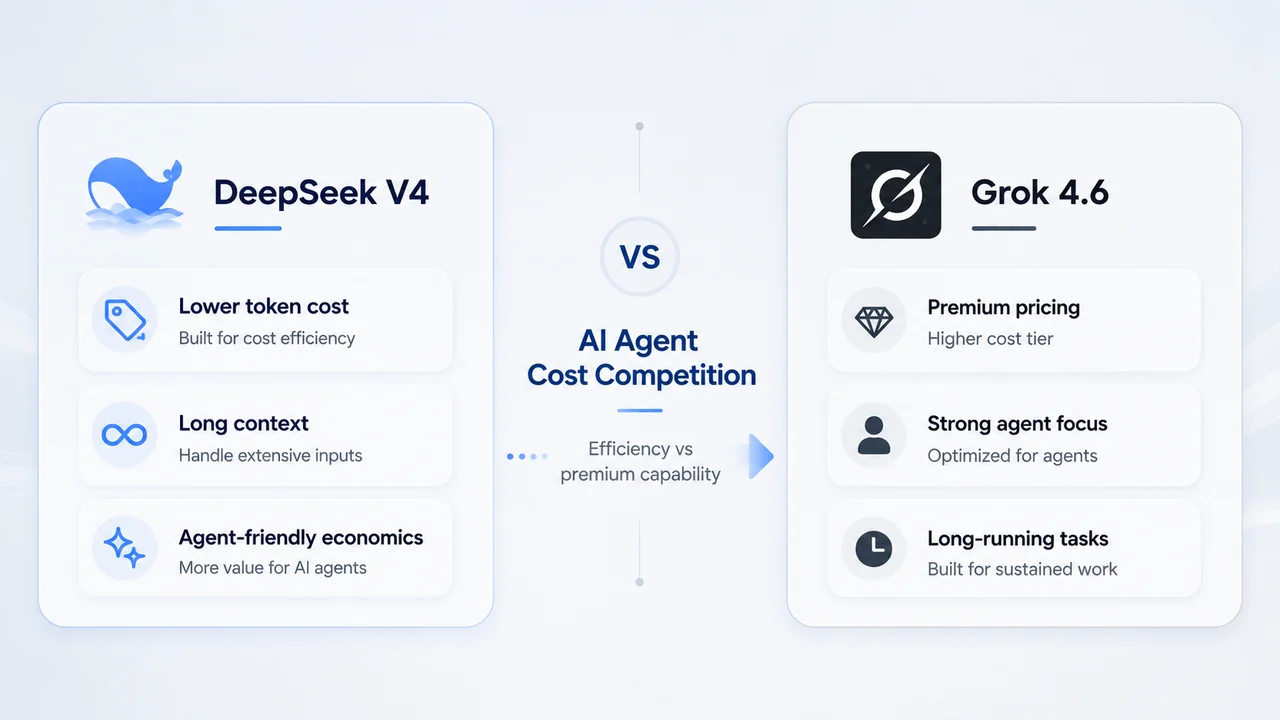
The next frontier-model fight may be less about who wins a benchmark and more about who can make autonomous AI work economically viable. SpaceXAI released Grok 4.6 on August 12 with an explicit focus on long-running agents, while DeepSeek V4 has been built around a different but complementary proposition: million-token context, aggressive inference efficiency, low API pricing, and easy substitution into existing agent stacks. Put the two together and the competitive question changes. The important number is no longer just dollars per million tokens. It is dollars per completed task.
The same agent market, very different price tags
Grok 4.6 is SpaceXAI’s new flagship model for coding, agentic tasks, and knowledge work. The company says it was trained specifically for longer multi-step trajectories and is available through its API, Grok Build, Cursor, and other partners. Its standard API price starts at $2 per million input tokens and $6 per million output tokens, with a 500,000-token context window.
DeepSeek V4-Pro sits at a very different price point. DeepSeek lists the model at $0.435 per million uncached input tokens and $0.87 per million output tokens, with cached input at $0.003625 per million tokens. It also supports a one-million-token context window. At list price, Grok’s standard input is about 4.6 times more expensive and its output about 6.9 times more expensive than DeepSeek V4-Pro.
The difference becomes more visible once an agent accumulates a large working context. SpaceXAI charges higher rates when Grok 4.6 requests exceed 200,000 context tokens: $4 per million input tokens, $1 per million cached tokens, and $12 per million output tokens. As a simple illustration, a turn using 300,000 input tokens and producing 50,000 output tokens would cost about $1.80 at Grok 4.6’s long-context rates. The same token volumes at DeepSeek V4-Pro’s current uncached-input and output rates would be about $0.174 — roughly a tenfold difference before considering task quality, retries, or tool costs.
That comparison is deliberately narrow. Token prices do not tell us which model is cheaper to employ. An agent that needs three attempts to finish a job can easily erase a lower per-token price, while a more expensive model that succeeds on the first pass may produce a lower total bill. But the list-price gap is large enough that production teams now have a meaningful economic reason to test model substitution rather than treating frontier models as interchangeable premium products.
Long context is turning into an infrastructure bill
Long-running agents consume context differently from chatbots. A coding agent may keep a repository map, source files, terminal output, test failures, tool results, plans, and prior decisions in its working history. A research agent can accumulate documents, web results, notes, and intermediate analyses. As that history grows, every subsequent model call can become more expensive in compute, memory, and billed tokens.
This is where DeepSeek’s architecture becomes a business story rather than a specification. V4-Pro is a 1.6-trillion-parameter mixture-of-experts model with 49 billion parameters activated per token. DeepSeek says that at a one-million-token context, V4-Pro requires only 27% of the single-token inference FLOPs and 10% of the KV-cache footprint of DeepSeek V3.2. Those gains do not directly translate into the public API price, but they help explain how DeepSeek can make very long context a standard product feature rather than an unusually expensive mode.
Grok 4.6 takes a different commercial approach: it offers a 500,000-token window, but explicitly charges more once requests cross the 200,000-token threshold. That is a useful signal for the broader market. Context length is no longer just a capability number on a model card. Providers are beginning to expose the real economics of keeping an agent’s working memory alive.
DeepSeek is also attacking switching cost
DeepSeek’s cost strategy is not limited to inference. Its API supports both OpenAI-compatible and Anthropic-compatible formats, and its documentation shows how developers can point tools such as Claude Code at DeepSeek simply by changing the API base URL, credentials, and model mapping. DeepSeek even recommends V4-Pro for the primary Claude Code model while routing lighter subagent work to V4-Flash.
That matters because the cost of changing AI suppliers is not only the new model bill. It includes integration work, evaluation, prompt migration, agent-harness changes, monitoring, and the operational risk of replacing a production dependency. Compatibility reduces some of that friction. A team can keep the interface or agent framework it already likes and test a different inference backend underneath it.
The Pro-and-Flash split adds another layer. DeepSeek says V4-Flash approaches V4-Pro on simpler agent tasks while being smaller, faster, and cheaper. That suggests a routing model for production agents: use lower-cost intelligence for classification, retrieval, routine edits, and subagent work, then escalate difficult reasoning or coding to Pro. The cheapest agent may not be the one that always calls the cheapest model; it may be the one that buys expensive intelligence only when the task actually needs it.
Why Grok can still justify a higher token price
A lower token price is not automatically a stronger business proposition. SpaceXAI is positioning Grok 4.6 around sustained execution. The company says the model is better at staying with complex tasks across many steps, has been trained on agentic reinforcement-learning environments, and shows more self-testing and verification on long trajectories. Its release benchmarks also show substantial gains over Grok 4.5 across coding and agent evaluations.
If those improvements reduce failed tool calls, repeated reasoning, human corrections, or abandoned tasks, a higher per-token price can be rational. An enterprise does not buy tokens for their own sake. It buys completed software changes, research reports, resolved support cases, analyzed documents, or other useful outcomes. Reliability can therefore be an economic feature just as much as cache pricing or sparse attention.
The metric that matters: cost per completed task
The cleanest way to compare agent models is not price per million tokens. It is total cost per successful, reviewable task. That total includes input and output tokens, cached context, tool calls, retries, latency, failed runs, verification, and the amount of human intervention needed before the result can be trusted.
This is also where today’s public evidence is incomplete. There is no standardized, production-grade head-to-head showing whether DeepSeek V4-Pro or Grok 4.6 delivers the lower cost per completed task across real agent workloads. Model-provider benchmarks are useful signals, but they do not substitute for a company measuring its own completion rate, retry count, latency, and review burden on the workflows it actually pays to automate.
What to watch next
Three things will show whether this becomes a real agent cost war. First, watch whether enterprise evaluations start publishing task-level economics rather than only benchmark scores. Second, watch pricing for cached and very long contexts, because persistent agent memory can dominate the bill as workflows stretch out. Third, watch model routing: if developers increasingly combine cheap subagents with a more capable escalation model, the market may shift away from choosing one flagship model and toward optimizing a portfolio of intelligence.
DeepSeek and SpaceXAI are approaching the same opportunity from different directions. DeepSeek is making frontier-style agent capability unusually cheap to call and easy to swap into existing software. Grok 4.6 is asking buyers to pay more for a model designed to stay on difficult work for longer. The winner will not necessarily be the model with the lowest token price or the highest benchmark. It will be the one that turns inference into useful work at the lowest total cost.
Sources and further reading
- DeepSeek V4 Preview Release - DeepSeek
- Models & Pricing - DeepSeek
- DeepSeek-V4-Pro model card and technical report - DeepSeek / Hugging Face
- Integrate with Claude Code - DeepSeek
- Introducing Grok 4.6 - SpaceXAI
- Grok 4.6 model and pricing - SpaceXAI